Back to: Linking to Care, Point of Care Testing (POCT). Aotearoa Edition
Let’s start with some of the very basic concepts in hygiene.
Our aim in these lessons covering hygiene is multi purposed. Obviously (we hope) we do not want to develop the very illness’ we are working towards screening, treating and ultimately contributing towards eliminating as significant public health threats in our communities. At the same time our efforts need to be medically professional, our actions seen as trained competent professional acts that can leave a lasting impression and possibly some level of education with our wai ora and people seeking care. And importantly we do not wish to pose a contamination or exposure threat to our wai ora and those around us.
In lessons 19 – 24 we will look at specific areas of hygiene in greater depth that relate to our practice as Health Network Collective representatives. None of this is difficult, however on occasion we may be required to get creative with the resources we have at hand to accomplish adequate hygiene and reduced risk of contamination. Importantly, our hygiene needs to be a constant focus, notably with planning and preparation… if we are not prepared and ready then we will be setting ourselves up for contamination, and potential infection.
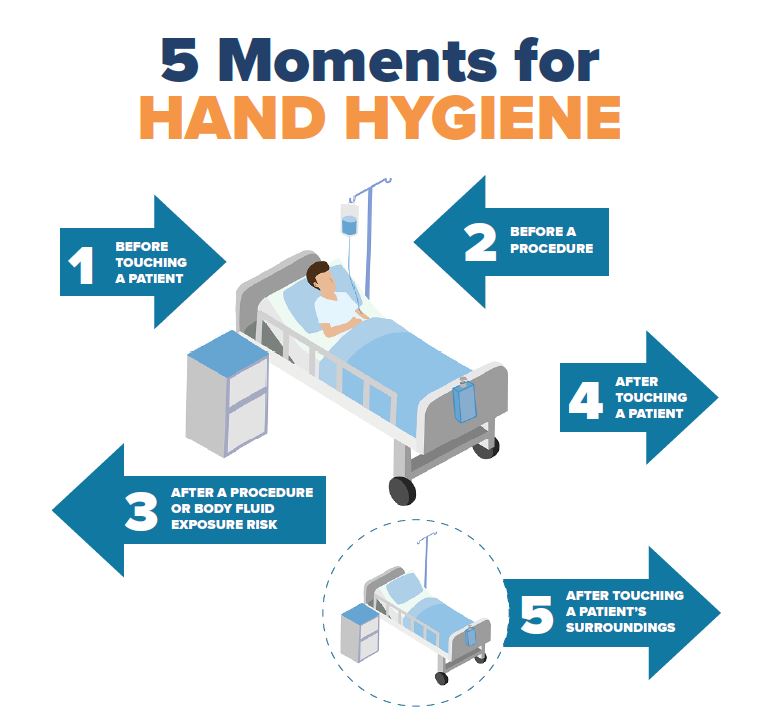
In the following lesson, lesson 19, we will take an in depth look at hand washing and how we wash our hands, adequately. The 5 moments for hand hygiene are a World Health Organization (WHO) designed initiative to minimize the risk of transmission of microorganism’s between kaiawhina, or healthcare worker, wai ora or patient, and the environment. We will start with the 5 moments of hand hygiene as this also describes the stage’s we will go through in interacting with our wai ora or people seeking care in a clinical sense. And the stages where we need to consider steps in hygiene practice
Moment 1. Before touching a patient. This is immediately before we touch our patient. This includes shaking our wai ora’s hand, assisting our wai ora in moving, touching their personal items such as glasses, passing them an item, or any interaction involving touching or exchange of items. Even if your intent is not to have some form of physical interaction with the wai ora or their belongings, it is good practice as the wai ora seeing your hygiene action of hand washing can be reassuring. After all our wai ora do not wish to be inadvertently contaminated or infected from or by you or the environment.
Moment 2. Before a procedure. Let’s consider procedure to include, however not limited to, any form of interaction with our patient. Especially clinical procedures. Our 5 moments for hand hygiene are not a strict step 1 to step 5 process. We need to look at the 5 moments pragmatically and apply a level of common sense in the 5 moments of hand hygiene application. In preparing for a procedure, we need to wash our hands, and again once we are set-up and ready to again touch our wai ora or patient. The equipment and testing environment needs to be kept as clean as possible so we reduce or mitigate risks of incidental contamination or transfer of microorganisms. This is not only about protecting ourselves; it is also about protecting our patients from us, and even our patients from themselves. Microorganisms and nasties can transfer from anywhere to anywhere or anyone. Even our own bodies such as our hands to our mouths.
Moment 3. After a procedure or body fluid exposure risk. Consider any procedure a fluid exposure or contamination risk. And any instance where blood or body fluids are present is an absolute risk, without question. We will discuss gloves and Personal Protective Equipment (PPE) in further lessons, these items are barriers enhancing protection, not a replacement or option for handwashing and hygiene. In the context of our Health Network Collective HCV antibody testing, cleaning up and appropriate disposal of procedure equipment is considered a part of the procedure, and it is at this stage we again wash our hands. An exception may be any instance where there is real or perceived contamination from any blood, fluids or substance that could pose contamination risk. This is one instance where you might or should decide to wash your hands and decontaminate as appropriate. If this means resetting and restarting the procedure again then that is absolutely fine. Act confidently and with professionalism, you and your wai ora will be better for it. It is always better to err on the side of caution than disregard the risks and possible consequences.
Moment 4. After touching a patient. This may coincide with after a procedure or body fluid exposure risk. This also includes any touching of the patient, which may simply be shaking hands on greeting or farewell, that’s if you do shake hands. As a side note it is not uncommon practice to only shake hands when offered by our wai ora, that is we do not offer or initiate handshakes. It is also common practice as a result of COVID that we do not shake hands or have polite social bodily contact.
Moment 5. After touching a patients surroundings. This a crucial and often overlooked moment for hygiene. Use of antimicrobial or antiseptic solutions, sprays or wipes on any surfaces used or surrounding procedures and areas of patient contact is common practice. This can include chairs furnishings and other items in the environment patients may have had contact with. This doesn’t mean we need to make a large-scale decontamination exercise for cleaning, imagine how you would feel faced with over-the-top cleaning procedures as wai ora. Subtle yet effective and appropriate timings can mean a lot and there is a difference between professional actions and appearance vs possibly reinforcing stigmatism or causing wai ora to feel as if they are contaminated…
In summary, the five (5) moments of hand hygiene are designed as a best practice guide to help us mitigate risks associated with microbial transfer and contamination. This helps in keeping us safe, from ourselves, others, environment and risks associated with the things that can make us and our wai ora unwell.
If possible, print off or draw a copy of the course material, “Your 5 moments for hand hygiene” available with this lesson and display in a prominent place as a reminder and as a potential educational aid for anyone who takes the time to read it.