Back to: Linking to Care, Point of Care Testing (POCT). Aotearoa Edition
We will dive deeper into obligations as part of Health Network Collective in further lessons. This lesson is about how we act in relation to our land and our people. And our obligations.
Originating in Aotearoa, New Zealand, Health Network Collective has an understanding of our obligations and way of being in consideration of equity and equitable ways of behavior. In Aotearoa Mana Whenua, ((noun) territorial rights, power from the land, authority over land or territory, jurisdiction over land or territory – power associated with possession and occupation of tribal land. The tribe’s history and legends are based in the lands they have occupied over generations and the land provides the sustenance for the people and to provide hospitality for guests), has an extensive powerful meaning and presence. Mana, ((verb) to be legal, effectual, binding, (noun) prestige, authority, status, spiritual power) is often linked with tapu ((stative) be sacred, prohibited, restricted, set apart) in this context. Whenua, ((noun) land) encompassing soil, rocks, plants animals and the people of the land, the tangata whenua, ((noun) local people, hosts, indigenous people – people born of the whenua). Land and people are intrinsically linked both spiritually and physically. Globally, we have an obligation to consult and collaborate with our kaitiaki ((noun) trustee, minder, guard, custodian, guardian), our indigenous peoples and their ancestors. Our host’s.
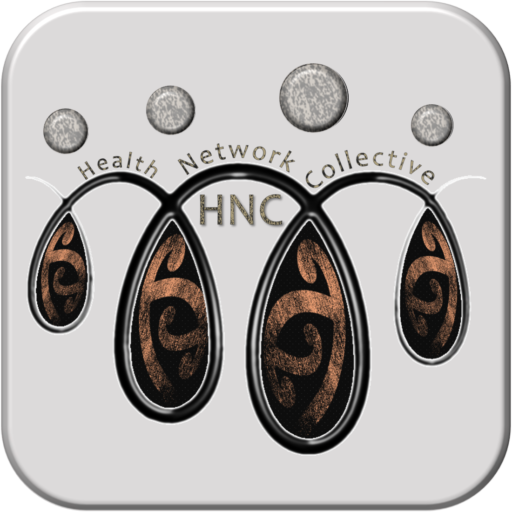
Health Network Collective’s kaupapa (principles or policies) are reflected in our logo
Hapori 1. (noun) section of a kinship group, family, society, community
Te aronga o te whanau (Family Direction). Whanau, ((verb) to be born, give birth, (noun) extended family, family group, a familiar term of address to a number of people – the primary economic unit of traditional Māori society. In the modern context the term is sometimes used to include friends who may not have any kinship ties to other members).
We are family and we are community. Health Network Collective is not about telling family and community what they need and how they need it.
Our obligation is to ask how we can help, our obligation is to share our knowledge and work towards collectively improving our family, our community, our society.
Te Whare Tapa Whā is Health Network Collective’s chosen model for development and growth. A holistic model of health that describes health as a wharenui/meeting house with four walls. These walls represent taha wairua (spiritual wellbeing), taha hinengaro (mental and emotional wellbeing), taha tinana (physical wellbeing) and taha whānau (family and social wellbeing)
“This is more than just a marae (meeting house) and an ātea (public forum), it is a nurturing place. It’s a place to be communal with each other. It’s one of healing, of social engagement and whakawhanaungatanga (process of establishing relationships). It’s a place to be one with each other.” Owen, Kaihautu/Māori Academic Advisor
What does this mean for us, we work collaboratively, together in a coordinated way to improve not only ourselves, but also the people around us. We use our skills, and the skills you will learn in this course, to enhance access to care and to enhance the community entities and systems in place. Our obligation is to our people and our community. Communicate, inform, and ask how can I help.